Regulation 15 June 2026
The 2026 AI Regulation Map
Where EU and UK rules actually stand, and what lands before your FY27 budget.
14 min read
Read →

Structured perspectives on AI readiness, architecture, governance and platform economics — published for enterprise leaders and technical decision-makers.
The failure rate is not random. The 20% did the architectural work. The 80% did not.

In ten weeks, the EU converts five years of digital sovereignty rhetoric into hard law — and any business that touches European data or sells to European customers is now on the clock.

You are not building for the agents you have today. You are building for the agents you will have in two years. The numbers are not on your side.

Every shortcut, every deferred fix, every "we'll get to it later". Mythos finds them all. The only question is what it costs when it does.

If standards, guardrails, and compliance requirements are defined up front, the work downstream becomes dramatically easier. Engineering teams receive not just code, but a blueprint. The handover stops being a translation exercise and starts being an implementation one.

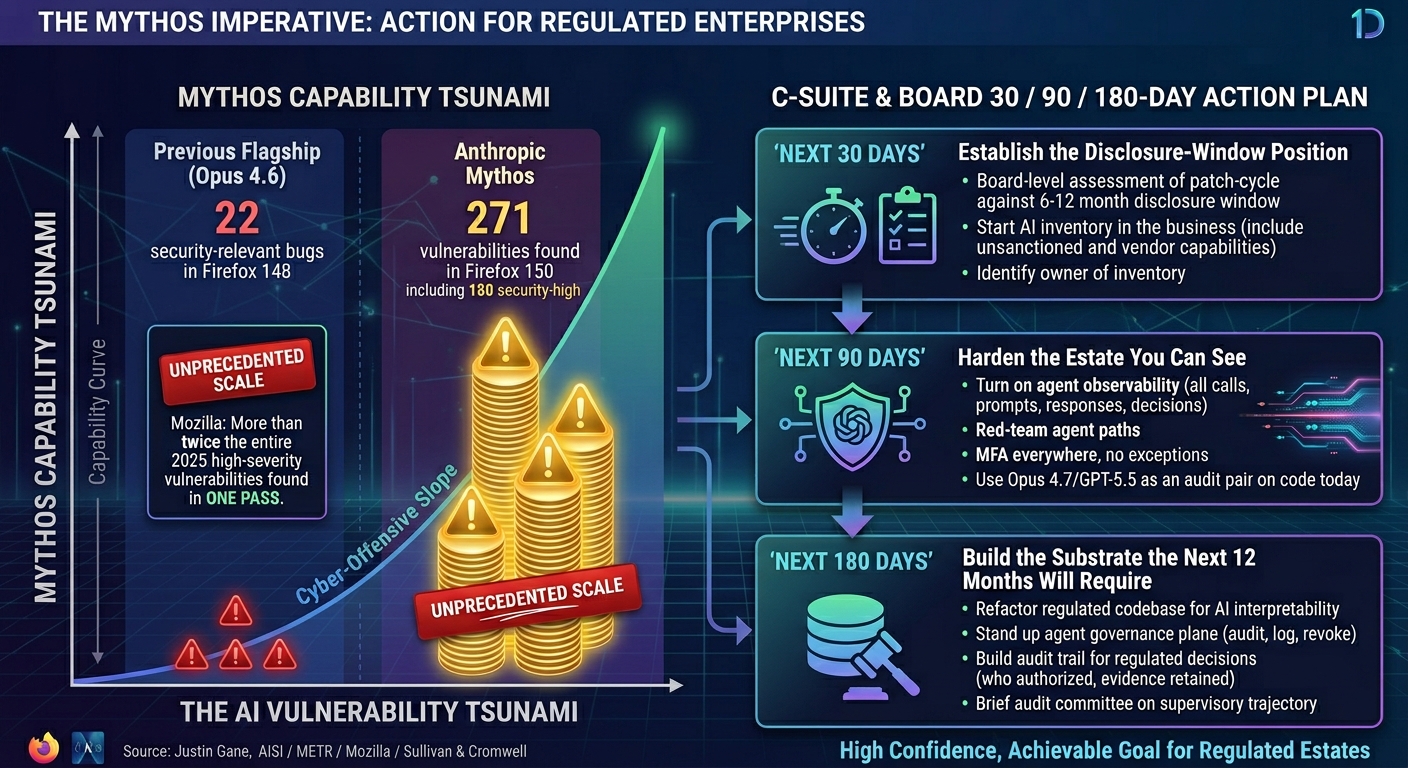
A reference piece for boards, audit committees and C-suites. Synthesised from Anthropic's own disclosures, AISI's UK government evaluation, Mozilla's Firefox 150 release, Palo Alto Networks's frontier-AI defence reports, METR's time-horizon benchmark, the Sullivan and Cromwell legal memo on the US Treasury and Federal Reserve convening, and the conversations we have been having with regulated firms over the last fortnight.
Enterprises allocate 70% of AI budgets to model development and tooling, but 80% of project failures trace back to data infrastructure. Inverting this ratio is the single highest-leverage change an enterprise can make.
Hyperscaler data warehousing is powerful but expensive. For most enterprise workloads, European sovereign alternatives deliver equivalent capability at a fraction of the cost.
Before investing in AI, understand your starting point. A structured assessment prevents costly false starts and ensures investment lands where it matters most.
Most organisations do not fail at AI because of models. They fail because their data is fragmented, siloed, and inconsistent.