This layer captures business capabilities using TOGAF business architecture principles. Capabilities are decomposed into value streams, mapped against strategic objectives, and assessed for AI applicability. Each capability is scored for automation potential, data readiness, and commercial impact before any technical design begins.
ARCHITECTURE
AI Architecture Framework
AI systems must be architected — not assembled. We design enterprise AI architecture grounded in TOGAF principles and structured for production.
PHILOSOPHY
Architecture Philosophy
Business capability mapping is the foundation of effective AI architecture. We apply TOGAF principles across four architecture domains to ensure every AI initiative is grounded in enterprise structure.
Business Architecture
Mapping business capabilities to AI opportunities. Understanding value chains, stakeholder needs, and strategic alignment before selecting any technology.
Data Architecture
Designing data flows, storage strategies, quality frameworks, and governance models that enable AI at enterprise scale.
Application Architecture
Defining how AI services integrate with existing application landscapes — APIs, microservices, event-driven patterns, and user interfaces.
Technology Architecture
Selecting infrastructure, platforms, and tooling that support scalable, secure, and cost-effective AI workloads.
"We do not start with models. We start with enterprise structure."
REFERENCE ARCHITECTURE
AI-Native Reference Architecture
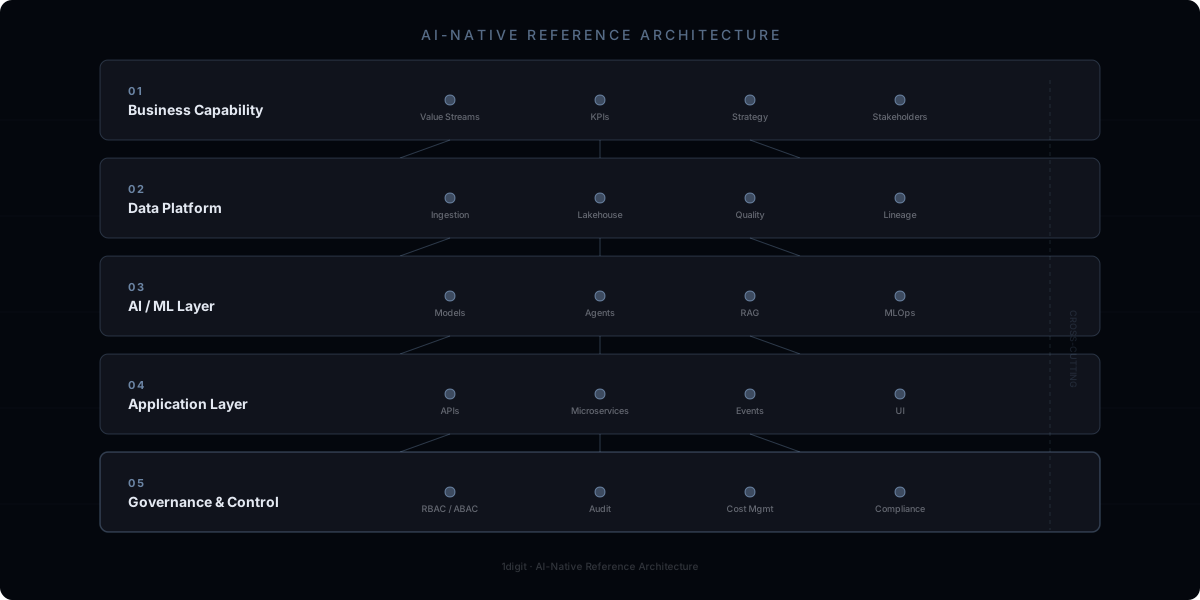
A layered architecture model designed for enterprise AI — from business capability through to governance and control.
01
01 Business Capability Layer
Defines what the organisation needs AI to achieve — mapped to strategic goals, KPIs, and value streams.
View technical detail
02
02 Data Foundation Layer
Ensures data is structured, governed, and accessible for AI consumption — from ingestion through to feature engineering.
View technical detail
Built on modern lakehouse principles, this layer implements medallion architecture (bronze, silver, gold) for data quality progression. It includes data cataloguing, lineage tracking, quality scoring, schema evolution management, and feature stores. Data contracts between producers and consumers are formally defined and monitored.
03
03 Platform & Orchestration Layer
The infrastructure backbone — compute, storage, networking, and workflow orchestration that powers AI workloads.
View technical detail
This layer abstracts infrastructure complexity through container orchestration (Kubernetes), serverless compute, and managed AI platforms. It includes ML pipeline orchestration (e.g. Airflow, Dagster), experiment tracking (MLflow), model registries, and resource management. Infrastructure-as-code ensures reproducibility and auditability across environments.
04
04 AI Services & Agent Layer
Where AI models, agents, and intelligent services are deployed, managed, and exposed to the business.
View technical detail
This layer encompasses model serving infrastructure, LLM orchestration frameworks (LangChain, LlamaIndex), agent architectures, RAG pipelines, and API gateway management. It includes prompt management, model versioning, A/B testing infrastructure, and fallback strategies. Multi-model routing enables optimal model selection based on task complexity and cost constraints.
05
05 Governance & Control Layer
Cross-cutting governance that ensures compliance, security, observability, and cost management across all layers.
View technical detail
Implemented as a cross-cutting concern spanning all layers, this includes RBAC and ABAC access control, audit logging, cost allocation and chargeback, compliance policy enforcement, drift detection, bias monitoring, and incident management. Governance is codified as policy-as-code and enforced through automated guardrails rather than manual review processes.
Secure SDLC Integration
Architecture is embedded into the delivery lifecycle — not treated as a one-off exercise. Every phase includes explicit architecture checkpoints and security controls.
"AI-first engineering is embedded in SDLC — not bolted on."
- Architecture review checkpoints
- Threat modelling
- Data classification
- Role-based access
- CI/CD guardrails
- AI evaluation frameworks
- Logging & observability by design
Security & Compliance Awareness
We design systems with security and compliance awareness at every layer. Our approach addresses AI-specific risks including prompt injection, data leakage, and auditability gaps.
Note: We align our practices with recognised standards such as ISO 27001 and SOC 2. Where we reference these standards, we indicate awareness and alignment — not formal certification — unless explicitly stated otherwise.
- ISO 27001 familiarity
- SOC 2 awareness
- Risk modelling
- Prompt injection mitigation
- Data leakage prevention
- Auditability
GOVERNANCE
Delivery Governance
Architecture without governance is just documentation. We implement milestone-based gates that ensure quality, alignment, and commercial viability at every stage.
Milestone-based architecture gates
Clear sign-off boundaries
Defined ownership models
Commercial modelling before scale
Discuss Your Architecture Landscape
Whether you are starting from scratch or modernising legacy systems, we can help you design an AI architecture that scales.
FAQ
Common Questions About AI Architecture
What enterprise leaders ask before starting an architecture engagement.
What is TOGAF-aligned AI architecture?
TOGAF (The Open Group Architecture Framework) is the most widely adopted enterprise architecture framework. 1Digit applies TOGAF principles specifically to AI systems — covering business capability mapping, data architecture, application architecture, and technology architecture — ensuring AI initiatives are grounded in enterprise structure rather than isolated as point solutions.
When does an organisation need an architecture engagement?
An architecture engagement is typically needed when: an organisation has multiple AI pilots that are not connected; when AI systems need to meet enterprise compliance and governance standards; when integrating AI with existing enterprise platforms (ERP, CRM, data warehouses); or when a board or regulator requires documented AI governance frameworks.
What are the deliverables from an architecture engagement?
Typical deliverables include: a current-state architecture assessment, target-state architecture blueprint, AI governance framework and policy templates, technology selection recommendations, and an implementation roadmap with milestones and commercial checkpoints. Engagement duration: 4–12 weeks.
How does your architecture work connect to data platforms and security?
Architecture, data platforms, and security are interconnected layers in 1Digit's framework. Architecture defines the structure; data platforms (Tachyon, Smart Lakehouse) provide the foundation; and governance, security, and compliance controls are embedded across all layers from day one.
Do you work on existing systems or only greenfield builds?
Both. We work with organisations modernising legacy systems and those building from scratch. Our assessment-first approach means we understand what you have before recommending change — and our TOGAF-based methodology handles both brownfield and greenfield scenarios.