TRUST & SECURITY

Built for Enterprise. Engineered for Trust.

Security, governance, and compliance are not afterthoughts. They are embedded into everything we build. Here is how we earn enterprise trust.

OUR PHILOSOPHY

Security Is Not an Afterthought

Security is not a feature we add at the end. It is a design constraint we apply from the beginning. Every architecture decision, every data flow, every deployment model is evaluated through a security lens before a single line of code is written.

Architecture-First Security

Data Privacy by Default

Governance by Design

Secure Delivery

Continuous Risk Management

SECURE SDLC

Enterprise-Grade Engineering

Every system we deliver passes through a security-integrated development lifecycle. These are not optional add-ons. They are mandatory checkpoints.
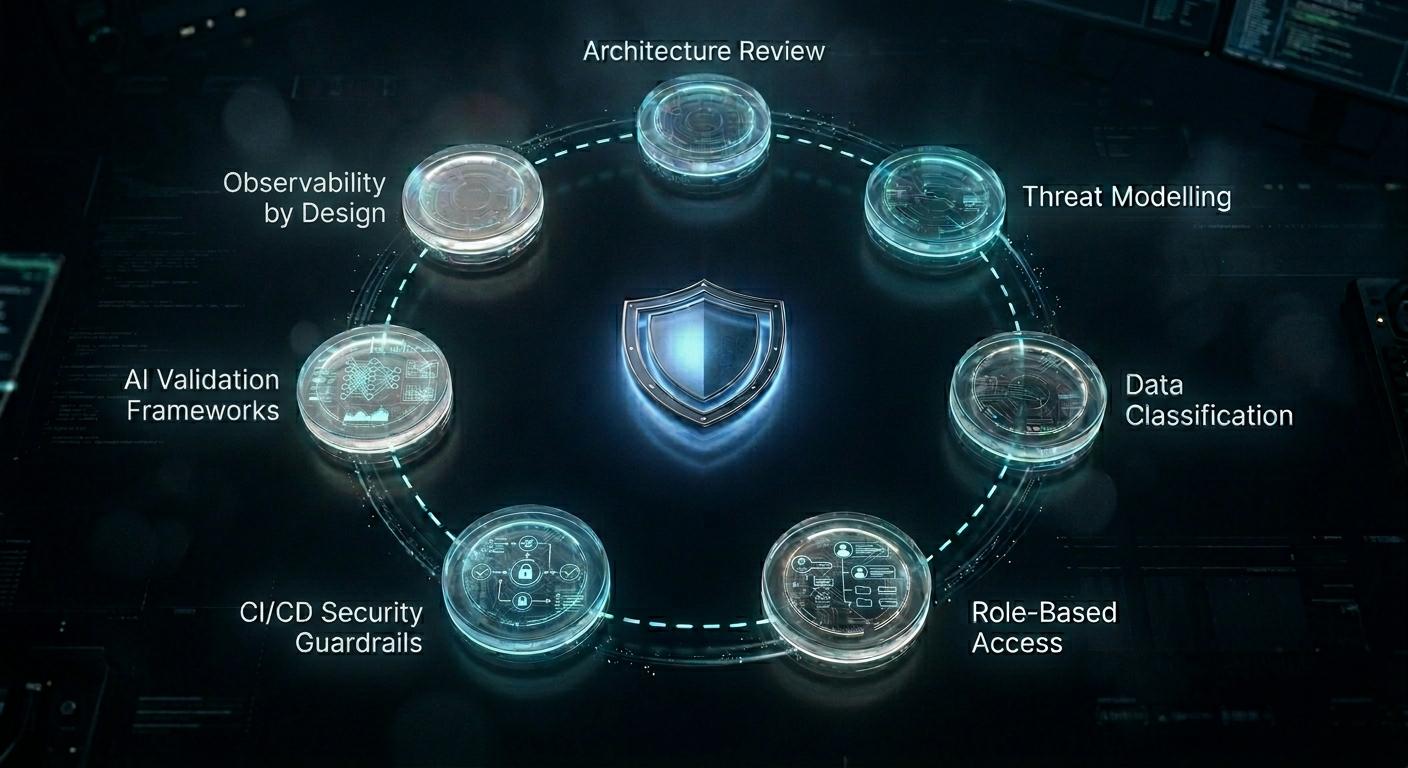
Secure Development Lifecycle — 7 phases in a continuous ring

Architecture Review Checkpoints

Security review gates at every architecture decision point, before implementation begins.

Threat Modelling

Structured threat modelling exercises before implementation, identifying attack surfaces and mitigation strategies.

Data Classification

Sensitivity mapping and data classification integrated into the design phase, not retrofitted after deployment.

Role-Based Access Design

RBAC designed from day one. Access patterns are architectural decisions, not afterthought configurations.

CI/CD Security Guardrails

Automated security scanning, dependency auditing, and policy enforcement embedded in every pipeline.

AI Validation Frameworks

Purpose-built evaluation and validation frameworks for AI components, including prompt security, output guardrails, and model governance.

Observability by Design

Logging, monitoring, and alerting built into the architecture, not bolted on after the first incident.

GOVERNANCE

Governance by Design

We do not bolt governance onto finished systems. We design it into the architecture from the start, using proven enterprise frameworks.

Layered Accountability

Clear ownership at every layer: data, application, infrastructure, and business logic.

Policy-as-Code

Governance policies codified and enforced automatically, not documented in PDFs that nobody reads.

Stakeholder Transparency

Decision trails visible to every stakeholder, from engineering to the board.

Framework Alignment

Architecture aligned with TOGAF, COBIT, and enterprise governance standards.

Measurable Controls

Every control has a metric. Every metric has a threshold. Every threshold has an action.

Enterprise governance and compliance verification

Framework Alignment

Our architecture governance follows TOGAF principles, not as a certification checkbox, but as a practical framework for maintaining architectural integrity across complex enterprise systems.

Auditability by Default

Every decision, every data transformation, every access event: traceable, versioned, and auditable.

Immutable Audit Trails

Every system action logged with tamper-evident records.

Data Lineage Tracking

Full traceability from source to consumption across every transformation.

Version-Controlled Decisions

Architecture and governance decisions tracked with full revision history.

Compliance Reporting

Automated reporting aligned to regulatory and internal audit requirements.

Real-Time Monitoring

Continuous monitoring dashboards with anomaly detection and alerting.

01
Action Logged
02
Tamper-Sealed
03
Lineage Traced
04
Version Tracked
05
Report Generated
COMPLIANCE

Compliance Familiarity

We design with compliance awareness from the start. Where we claim familiarity, not certification, we are transparent about it.

ISO 27001

Information security management awareness and alignment. Our engineering practices follow ISO 27001 control objectives for access management, cryptography, and operational security.

SOC 2

Security, availability, and confidentiality awareness. We design systems that support SOC 2 audit readiness for enterprise clients who require third-party assurance.

GDPR

European data protection regulation compliance. Data minimisation, consent management, right to erasure, and cross-border transfer awareness built into data architecture.

POPIA

South African data protection alignment. Processing limitation, purpose specification, and information officer support designed into every system handling personal information.

Design Principles

  • Privacy by design, not privacy by retrofit
  • Data minimisation as an architectural constraint
  • Consent management integrated at the data layer
  • Right to erasure built into data lifecycle management
  • Cross-border data transfer awareness in deployment architecture
ISO 27001 SOC 2 GDPR POPIA
AI RISK

AI-Specific Risk Controls

AI introduces risks that traditional security frameworks were never designed to address. We build controls specifically for these emerging threat vectors.

The Unsettling Reality

Most enterprise AI deployments have no formal security controls. No prompt injection prevention. No output validation. No model governance. The attack surface is expanding faster than most organisations can comprehend.

Prompt Injection Prevention

Input sanitisation, context boundaries, and injection detection layers for every LLM integration.

Data Leakage Prevention

Classification-aware guardrails preventing sensitive data from entering or exiting AI systems without authorisation.

Hallucination Monitoring

Output validation frameworks that detect, flag, and contain model hallucinations before they reach downstream systems.

RBAC for AI Systems

Granular access control for model endpoints, training data, and inference results. Not one API key for everything.

Output Guardrails

Structured validation and content filtering on every AI output before it reaches users or downstream systems.

Model Governance

Version control, performance monitoring, drift detection, and lifecycle management for every deployed model.

Our Controls

Input validation and sanitisation at every AI boundary
Output classification and filtering before distribution
Model access controls with principle of least privilege
Automated drift detection and performance monitoring
Incident response playbooks specific to AI failure modes
Regular adversarial testing and red-team exercises
! ! ! ! ! ! Prompt Injection Data Leakage Hallucination Output Bias Model Drift Unauthorized Access CONTAINMENT BOUNDARY
ENTERPRISE DELIVERY

Enterprise Delivery Experience

We deliver into enterprise environments, not startup sandboxes. Our delivery process reflects the governance, security, and stakeholder management that enterprise clients require.

Security Architecture Review

Every engagement begins with a formal security architecture review: threat modelling, data classification, and compliance mapping before a single line of code.

Stakeholder Governance Alignment

We align with your existing governance structures: architecture review boards, change advisory boards, and security committees.

Controlled Deployment Pipelines

CI/CD pipelines with security gates, automated testing, and staged rollouts. No cowboy deployments.

Documentation and Knowledge Transfer

Comprehensive runbooks, architecture decision records, and operational documentation. Not a GitHub README.

Ongoing Monitoring and Support

Post-deployment monitoring, incident response integration, and continuous security assessment as part of every engagement.

Security does not slow innovation. Poor architecture does.